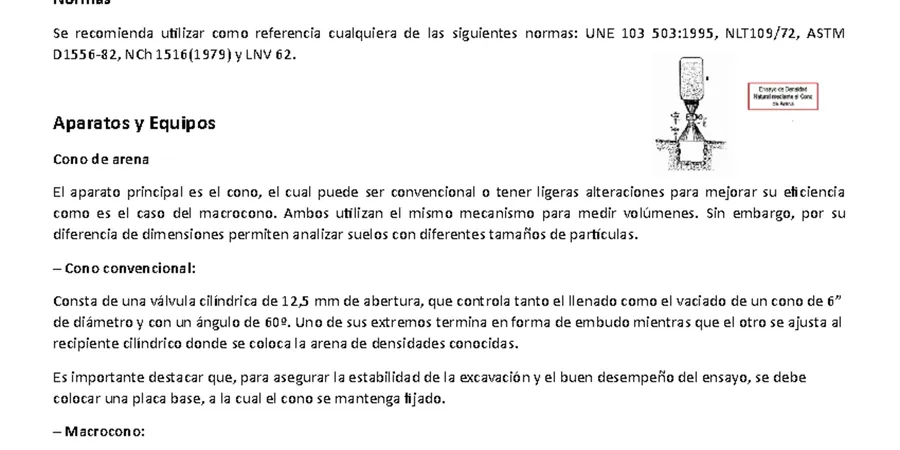
Beneath Grande Prairie, the clay-rich glacial till and occasional silt lenses of the Smoky Group pose a real compaction challenge. At 55.1711 degrees north, freeze-thaw cycles work the upper soil profile hard, and loose backfill is a common culprit behind settlement in commercial pads along the Resources Road corridor. The sand cone method, run per ASTM D1556, gives us a direct measure of in-place density right at the construction cut. We use it every season on building pads, approach fills, and trench reinstatements where nuclear gauges are either impractical or require an alternate verification. When the proctor curve comes from a lab running Proctor tests, the field density result ties straight back to percent compaction—the number the City inspector wants to see before the next lift goes down.
A sand cone test on Grande Prairie till isn't just about a number. It's about confirming that the compactor is beating the freeze-thaw memory out of the soil before the first frost returns.
Methodology and scope
Local considerations
Grande Prairie grew fast during the Montney gas play, and plenty of early commercial buildings went up on pads compacted with whatever was on hand. Over time, differential settlement showed up in door frames, drywall cracks, and slab heave. The sand cone test, placed at the right frequency during construction, catches low-density pockets before they become latent defects. The biggest risk we see now is in winter-built pads where frozen lumps get rolled into the fill—they pass a density test on the day but consolidate into soft spots after thaw. A pattern of sand cone readings across a grid tells the compaction story that a single spot check misses. For slopes or approach fills where stability matters beyond settlement, the density data feeds directly into a slope stability assessment that considers the actual placed unit weight, not just the assumed lab value.
Applicable standards
ASTM D1556 – Standard Test Method for Density and Unit Weight of Soil in Place by the Sand-Cone Method, ASTM D698 – Standard Test Methods for Laboratory Compaction Characteristics (Standard Proctor), CSA A23.1 – Concrete Materials and Methods of Concrete Construction (referenced for subgrade preparation), City of Grande Prairie Engineering Design and Construction Standards – Earthworks and Compaction
Associated technical services
Standard & Modified Proctor
Laboratory compaction curves (ASTM D698 / D1557) on representative bulk samples taken from the site or the designated borrow pit. The Proctor maximum dry density and optimum moisture become the reference for every sand cone test that follows.
Nuclear Gauge Density (correlation)
On large-area pads where sand cone tests serve as the primary control, we run nuclear gauge traverses for rapid screening between sand cone locations. Each gauge day starts with a sand cone correlation point to keep the numbers tied to ASTM D1556.
Trench Backfill Verification
Utility cuts in Grande Prairie's clay till require lift-by-lift compaction checks. We test at the specified interval—usually every 300 mm of compacted depth—and report percent compaction against the project's acceptance criteria before the asphalt patch is placed.
Typical parameters
Frequently asked questions
How much does a sand cone density test cost in the Grande Prairie area?
A single sand cone field density test typically runs between CA$150 and CA$180 when performed as part of a scheduled site visit. The exact amount depends on how many tests are done in one mobilization and the travel distance from our nearest staging point. A half-day program with four to six tests is the most cost-effective setup for most smaller commercial pads.
How many sand cone tests does the City of Grande Prairie require on a building pad?
The City's engineering standards generally require one field density test per lift per 250 square metres of pad area, with a minimum of three tests per lift. For trench backfill, frequency is typically one test every 15 linear metres per lift. Specific requirements are laid out in the approved project drawings and the City's construction specifications, so we always cross-check the testing plan with the permit conditions before starting.
Can you run a sand cone test on gravelly Grande Prairie till?
Yes, provided the maximum particle size is about 50 millimetres or less. When the till contains larger cobbles, the excavation volume becomes too small to be representative, and we switch to a water-replacement method or a large-scale field density test. Most commercial pads in Grande Prairie sit on reworked till where the coarse fraction is well within the sand cone range.
How do you keep the sand cone accurate during freeze-thaw season?
The reference range for this service in Grande Prairie is CA$150 - CA$180. The final price depends on the project scope and volume.
What documentation do I get after the field density test?
Every test comes with a field report that includes the test location on a site plan, the measured wet and dry density, the moisture content, the percent compaction referenced to the lab Proctor, and a pass/fail statement against the specification. The report is signed by the testing technician and emailed within 24 hours. For long-running projects, we also maintain a running summary table so the earthworks contractor can track trends lift by lift.