In Grande Prairie, the transition from the shallow gravels of the Bear Creek floodplain into the deep lacustrine clays of the Smoky Group presents a sharp geotechnical boundary. Tunnel alignments crossing that boundary will see the face change from stable overconsolidated till to squeezing soft clay in less than fifty meters. That shift demands more than a standard site investigation—it requires a targeted soft ground analysis that captures the undrained shear strength profile, consolidation behavior, and time-dependent deformation of the clay. Our work focuses on that transition zone. We combine in-situ permeability testing data with laboratory triaxial campaigns to build the constitutive parameters that feed directly into finite-element tunnel models.
In Grande Prairie’s Smoky Group clays, a one-percent increase in water content can reduce the undrained shear strength by fifteen percent—tunnel stability turns on the moisture profile.
Methodology and scope
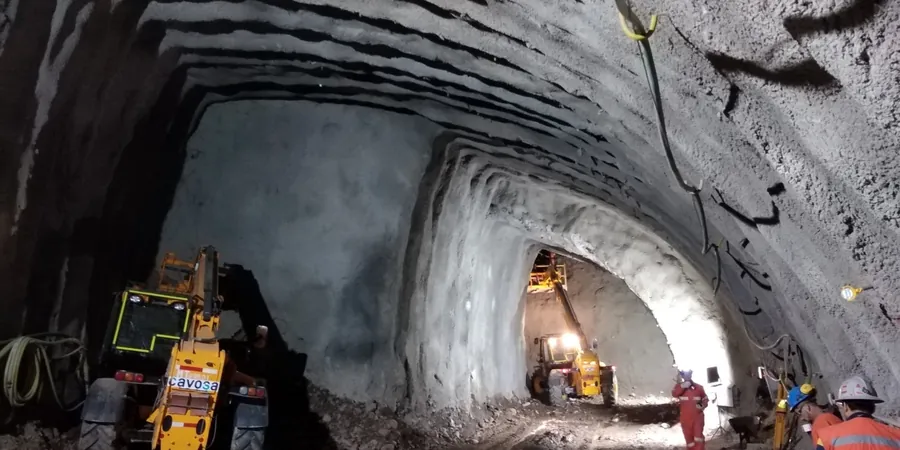
Local considerations
The primary risk in soft-ground tunneling is face instability leading to uncontrolled chimney collapse, especially where the clay contains discontinuous silt seams. Those seams act as drainage paths, accelerating pore-pressure drawdown and triggering localized undrained failure. A secondary risk in Grande Prairie is long-term consolidation settlement beneath shallow utilities—particularly along 100 Street where older cast-iron water mains sit within the settlement influence zone. We quantify this risk through coupled flow-deformation analysis using the Modified Cam Clay model calibrated to local lab data. Without that calibration, the predicted settlement can be off by a factor of three, leaving the contractor exposed to post-construction claims.
Applicable standards
ASTM D4767-11 (Consolidated Undrained Triaxial), ASTM D2435/D2435M-11 (One-Dimensional Consolidation), NBCC 2020, Division B, Part 4 (Structural Design), ITA WG2 Guidelines for Soft Ground Tunnelling
Associated technical services
Advanced Laboratory Testing Program
Consolidated-undrained and drained triaxial tests on undisturbed Shelby tube samples, oedometer consolidation tests with load-unload cycles, and constant-volume direct simple shear for clay sensitivity. All testing performed at our ISO 17025-accredited lab with data delivered in Plaxis- and FLAC-ready formats.
Face Stability and Settlement Assessment
Limit-equilibrium wedge analysis for TBM face pressure windows, empirical volume-loss estimates using the Gaussian trough method calibrated to local grain-size profiles, and 2D finite-element modeling of sequential excavation for SEM headings in mixed-face conditions.
Typical parameters
Frequently asked questions
What is the typical cost range for a soft-ground tunnel geotechnical analysis in the Grande Prairie area?
Depending on the number of boreholes, the depth of the alignment, and the extent of laboratory testing required, a complete soft-ground tunnel analysis in Grande Prairie typically ranges from CA$6,140 to CA$21,230. A shallow utility tunnel with two boreholes and basic triaxial testing falls at the lower end, while a deep sewer interceptor requiring multiple Shelby tube pushes, consolidation tests, and FE modeling approaches the upper end.
Which laboratory tests are essential for characterizing the Smoky Group clays for tunneling?
Consolidated-undrained triaxial tests are the cornerstone—they provide the undrained shear strength and pore-pressure response needed for face-stability calculations. Oedometer consolidation tests capture the compressibility that drives surface settlement predictions. Atterberg limits and grain-size distributions on every tube sample allow us to correlate strength trends along the alignment, reducing the number of expensive triaxial specimens without sacrificing model accuracy.
How do you determine the TBM face pressure window in soft clay?
We combine the undrained shear strength profile from triaxial testing with a limit-equilibrium wedge analysis that accounts for the overconsolidation ratio and the presence of any silt seams. The lower bound prevents face collapse; the upper bound avoids blow-out. The window narrows significantly where the clay sensitivity exceeds four, which is common in the deeper Smoky Group deposits beneath Grande Prairie.
What is the turnaround time for the lab testing and analysis report?
Standard triaxial and consolidation testing requires three to four weeks from sample arrival to final report. Where a project timeline demands faster results—for example, when a TBM is approaching a known transition zone—we can expedite a focused testing program and deliver critical parameters within five business days. The expedited scope is agreed upon in advance to ensure the right tests are prioritized.