When we get called out to a site near the Smoky River or up toward the Kleskun Hills, the first thing we look at is the rhythm of the glacial stratigraphy. In Grande Prairie, you are rarely dealing with a single homogeneous deposit; more often it is a layered sequence of clay tills interbedded with silty sand lenses, and that changes the whole approach to a field permeability test. A standard lab perm on a Shelby tube sample will tell you something about the matrix, but it will not capture the connectivity of sand seams that can drain an excavation overnight. That is where the Lefranc test, and on occasion the Lugeon test in weathered bedrock, become the only way to get a representative mass hydraulic conductivity. We run these tests following ASTM D6391 for the Lefranc method and the Houlsby interpretation for Lugeon packer testing, and we always cross-check the results with a CPT soil profiling when the stratigraphy is uncertain, because a single sand lens misidentified as clay can turn a dry cut into a pumping emergency.
A single unmeasured sand lens in a Grande Prairie excavation can move more water in an hour than the surrounding clay till moves in a month.
Methodology and scope
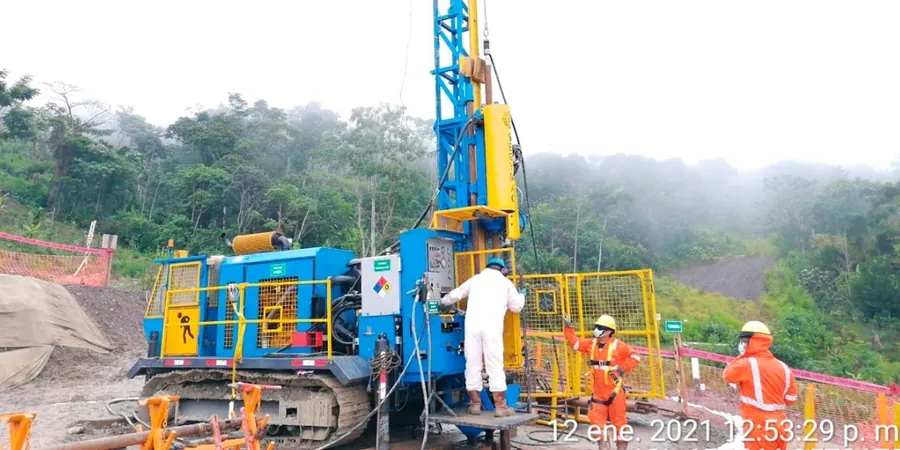
Local considerations
The NBCC 2015 requires that foundation and excavation designs account for realistic groundwater pressures, and in Grande Prairie the default assumption of hydrostatic full-depth pressure can be either overly conservative or dangerously optimistic depending on the subsoil drainage path. We have seen projects along Resources Road where the contractor assumed a low-permeability till would act as a natural cutoff, only to hit a pressurized sand lens at six meters that required a complete redesign of the sumping capacity. A Lefranc test performed early in the investigation would have identified that lens and allowed the design team to size the dewatering system correctly. The real risk is not just flooding; it is heave and piping at the base of an excavation when the upward gradient exceeds the critical gradient of the soil. That is a factor of safety problem that cannot be solved without a field-measured k-value, because remolded lab samples simply do not preserve the in-situ fabric that controls flow. For deeper excavations near the Bear Creek corridor, we often recommend running a slope stability analysis in parallel, because the groundwater regime directly influences the effective stress and the stability of cut slopes during spring thaw.
Applicable standards
ASTM D6391-11 (Field Measurement of Hydraulic Conductivity by Borehole Infiltration Tests), Houlsby A.C. (1976) Routine Interpretation of the Lugeon Water-Test, NBCC 2015 Part 4 – Structural Design, Groundwater Load Provisions
Associated technical services
Lefranc Borehole Permeability Test
Constant or falling head test performed in a cased borehole with a slotted screen. We isolate the test interval with a bentonite seal and measure flow rates at steady state to calculate the in-situ hydraulic conductivity. Ideal for the glacial tills and interbedded sands typical of Grande Prairie.
Lugeon Packer Test in Bedrock
Packer test conducted in NQ or HQ core holes into the Wapiti Formation or underlying shale. We apply five pressure stages and measure water take, generating a Lugeon pattern that reveals fracture dilation, washout, or laminar flow behavior. Essential for dam abutments and deep shafts.
Falling Head Slug Test
Rapid, low-cost method for tight formations where a constant head test would take too long. We displace the water column and record the recovery curve with a pressure transducer, fitting the data to the Hvorslev or Bouwer-Rice solution for k.
Dewatering Feasibility Assessment
We combine multiple Lefranc tests across the site to map the three-dimensional permeability distribution, then work with the contractor to estimate steady-state pumping rates, well spacing, and drawdown timelines for open-cut and shored excavations.
Typical parameters
Frequently asked questions
When should I choose a Lefranc test over a lab permeability test for a Grande Prairie site?
You choose the Lefranc test whenever the soil fabric matters. The glacial tills around Grande Prairie contain fissures, sand partings, and occasional gravel seams that a small Shelby tube sample misses entirely. A lab test on a 75-mm specimen gives you the matrix conductivity, but the Lefranc test measures the mass conductivity over a screened interval of half a meter or more, capturing the influence of those preferential flow paths. That is the number your dewatering contractor actually needs.
What is a Lugeon value and how do you interpret it for the local bedrock?
A Lugeon is a unit of water take defined as one liter per minute per meter of test interval at an injection pressure of 1 MPa. In the Wapiti Formation sandstone we encounter around Grande Prairie, a value below 1 Lugeon typically indicates very tight rock with negligible fracture flow, 1 to 5 suggests moderate jointing, and above 5 Lugeons points to open fractures or interconnected joint sets that will dominate the groundwater regime. We always look at the shape of the pressure-versus-Lugeon curve to distinguish between laminar flow, turbulent flow, and fracture dilation or washout.
What is the typical cost for a field permeability test in the Grande Prairie area?
For a single Lefranc test in a standard borehole, you can expect a cost in the range of CA$940 to CA$1,280, which includes the drilling setup, test execution, data reduction, and a brief report with the calculated k-value. Lugeon testing runs toward the upper end and beyond, depending on the packer configuration and the number of pressure stages. The final number moves with the depth, the casing requirements, and how many tests you need across the site to characterize the variability.