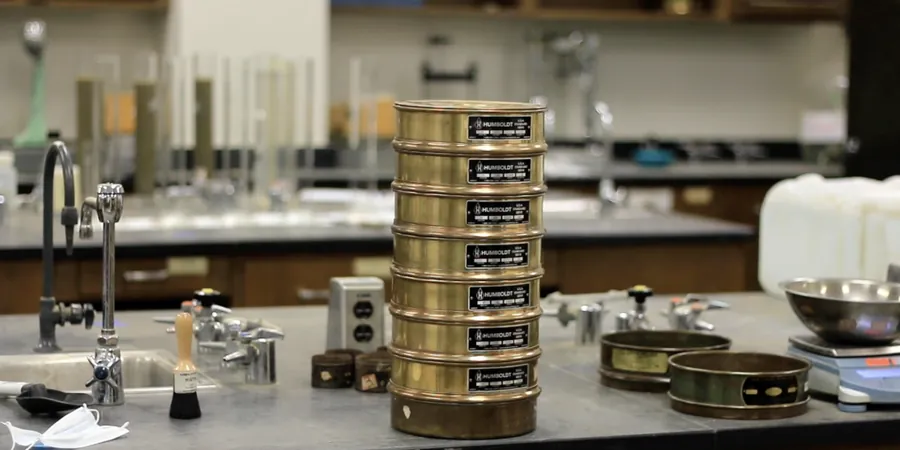
Grande Prairie grew fast—from a fur trading post on the Smoky River basin to the hub of the Peace Country oil and gas patch. That speed left a mix of glacial till, lacustrine silts, and alluvial sands under thousands of commercial buildings and residential subdivisions. When you strip the topsoil, you’re almost always looking at a complex profile where grain size controls drainage, frost action, and bearing behavior. A standard grain size analysis with sieves alone misses the fines that dictate frost heave potential. We run the full ASTM D422 package—mechanical sieves down to 75 µm plus hydrometer on the minus 200 fraction—because in this region, the silt content is the variable that makes or breaks a foundation. For deeper exploration, we often pair it with test pits to log the stratigraphy and sample the layers that really matter.
If you don’t know the silt and clay fraction in a Grande Prairie till, you’re designing a foundation blind.
Methodology and scope
Local considerations
A few winters back, we got called to a tilt-up warehouse south of Resources Road where the slab had heaved more than 40 mm in the first season. The original geotech report listed the subgrade as “silty sand, trace clay” based on a field log and a quick sieve wash. When we ran the full hydrometer suite on undisturbed samples, the fines content came back at 22% with a liquid limit of 28—classic frost-susceptible material per the USACE criteria. The fix involved undercutting half a meter, installing geotextile, and placing a non-frost-susceptible granular pad. The cost of that remediation was roughly ten times what the complete grain size analysis would have cost at design stage. In the Peace Country, where the temperature swings from +30°C in July to −40°C in January, skipping the hydrometer on silty tills is a gamble that rarely pays off.
Explanatory video
Applicable standards
ASTM D422 Standard Test Method for Particle-Size Analysis of Soils, ASTM D7928 Standard Test Method for Particle-Size Distribution (Gradation) of Fine-Grained Soils Using the Sedimentation (Hydrometer) Analysis, ASTM D2487 Standard Practice for Classification of Soils for Engineering Purposes (Unified Soil Classification System)
Associated technical services
Full particle-size distribution package
Mechanical sieve analysis on the coarse fraction plus hydrometer sedimentation on the minus 200 material. We deliver the complete grading curve, D-values, and USCS classification ready for the geotechnical report.
Frost-susceptibility screening
Focused hydrometer testing targeting the silt and clay fractions, combined with Atterberg limits when plasticity is suspected. This package is specifically designed for subgrade evaluation under parking lots, roadways, and shallow foundations in the Grande Prairie frost zone.
Typical parameters
Frequently asked questions
How much does a grain size analysis with hydrometer cost in Grande Prairie?
For a standard combined sieve and hydrometer test on a single sample, budget between CA$150 and CA$250 depending on whether we need to run Atterberg limits alongside it. Multiple samples from the same borehole or test pit usually get a volume discount—give us a call with your project specs and we’ll send a firm quote the same day.
Why can’t I just do a sieve analysis without the hydrometer?
A sieve analysis stops at 75 µm and lumps everything finer as “passing 200.” In Grande Prairie’s glaciolacustrine silts, that fraction can be 15–40% of the total sample and it controls frost heave, permeability, and compaction behavior. The hydrometer separates silt from clay and gives you the D10, D30, and D60 needed for a proper USCS classification. Without it, you’re missing the data that dictates subgrade treatment thickness and insulation requirements under the National Building Code.
How long does the test take and what sample size do you need?
Standard turnaround is three to four business days from sample receipt to report. The hydrometer portion requires a 24-hour sedimentation reading series, so rush jobs are possible but tight. We need about 500 grams of fine-grained soil or up to 5 kg if the material is coarse and gravelly. Double-bag the sample in heavy-duty zip-locks and keep it at natural moisture if you also need water content—dried-out silts can give misleading hydrometer results.