The upper Peace River basin around Grande Prairie is underlain by extensive glaciolacustrine deposits—soft, compressible clays and silts that can exceed 15 m in thickness. These soils, deposited in glacial Lake Peace, present real challenges for foundations and embankments. Standard shallow footings often fail to meet settlement criteria here. Stone column design offers a proven ground improvement alternative: we install dense, compacted gravel columns that reinforce the native soil and accelerate drainage. For projects east of Bear Creek, where the water table sits within 2 m of the surface, the rapid consolidation provided by stone columns becomes a decisive advantage. Our approach integrates site-specific test pits to map the clay stratigraphy before any column layout is finalized.
In Grande Prairie's glaciolacustrine clays, stone columns reduce post-construction settlement by 60 to 80 percent while cutting consolidation time from years to weeks.
Methodology and scope
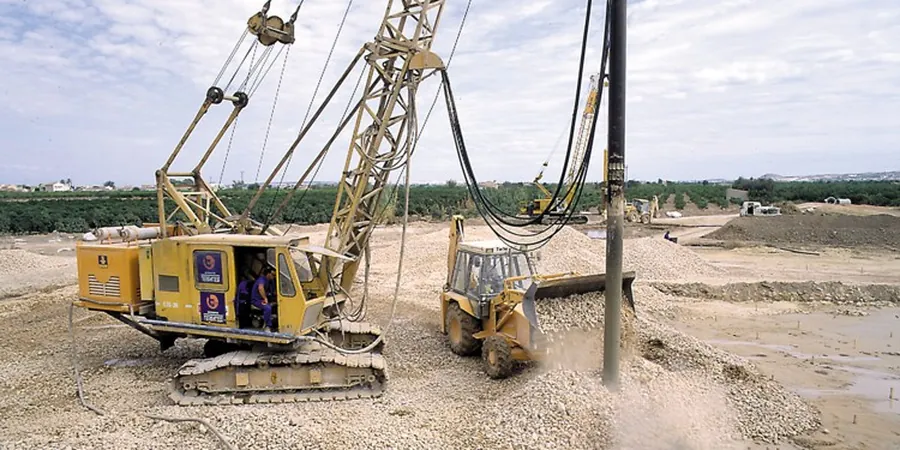
Local considerations
NBCC Division B, Part 4 requires that any foundation system on compressible soils limit total and differential settlement to values compatible with the superstructure. In Grande Prairie, the risk of excessive settlement is magnified by the seasonal fluctuation of the water table—winter freeze-thaw cycles can soften the upper crust of desiccated clay, reducing its bearing capacity just as construction activity ramps up in spring. Poorly designed stone columns that don't fully penetrate the soft layer, or that use aggregate prone to clogging by silt, can lead to long-term performance failures. To mitigate this, our design methodology follows the Priebe method with site-specific modulus inputs, and we specify a working platform of well-graded gravel to maintain column integrity during installation—especially critical when the clay has a liquidity index above 1.2.
Applicable standards
NBCC 2020 Division B, Part 4 (Foundations), ASTM D6913-04 (Particle-Size Distribution of Soils), CFA Stone Column Design Manual (Deep Foundations Institute guidelines), ASTM D1586-18 (Standard Penetration Test for correlation with Priebe method), CSA A23.3-14 (Concrete structures for ground-supported slabs)
Associated technical services
Priebe-Based Stone Column Design
Detailed design package with column grid layout, area replacement ratio, aggregate specification, and settlement analysis calibrated to the compressible clays of the Peace River lowlands. Includes liquefaction assessment where required under NBCC seismic provisions.
Construction-Phase QA/QC and Load Testing
On-site verification during vibro-replacement installation: aggregate gradation checks, column continuity logging, and post-installation modulus or zone load tests to confirm the composite ground meets the design stiffness. Documentation for municipal permit close-out in Grande Prairie.
Typical parameters
Frequently asked questions
What is the typical cost range for stone column design and installation in Grande Prairie?
For most projects in the Grande Prairie area, stone column packages—including site investigation, design, installation, and verification testing—fall between CA$1,820 and CA$7,050 for small to medium footprints. Larger industrial sites with deep soft clay zones will naturally trend toward the upper end. A site walk and review of existing borehole logs allows us to provide a fixed-scope proposal.
How deep do stone columns need to go in the Grande Prairie area?
Column depth is dictated by the thickness of the soft glaciolacustrine layer. In Grande Prairie, columns typically extend 6 to 15 m to bear on the underlying competent glacial till or to achieve sufficient confinement. We identify the target depth through CPT soundings or SPT borings; columns must fully penetrate the compressible zone to prevent a punching failure beneath the improved block.
Can stone columns be used under large-diameter storage tanks near the city?
Yes. Stone columns are frequently specified beneath ASTs and small silos on the soft clays surrounding Grande Prairie. The design accounts for edge-to-center differential settlement under hydrotest loading, and the drainage function of the columns accelerates consolidation so the tank can be placed into service sooner than under surcharge-only programs.
How long does it take for the improved ground to consolidate after stone column installation?
Because stone columns provide vertical drainage paths spaced 1.5 to 3 m apart, the radial drainage distance is drastically reduced. In the silty clays typical of Grande Prairie, 90 percent of primary consolidation often completes within 2 to 6 weeks, compared to 2 to 5 years for untreated soil. We monitor pore pressure dissipation with vibrating-wire piezometers to confirm readiness for foundation construction.
What verification methods do you use to confirm column performance?
We specify a combination of post-installation CPT soundings through selected columns, modulus load tests on individual columns or groups, and occasionally full-scale zone load tests. The test program is designed to demonstrate that the composite ground achieves the design modulus and friction angle, and that column continuity extends to the design depth without necking or bulging in the soft clay layers.