Grande Prairie sits atop complex sequences of glacial till, glaciolacustrine silts, and preglacial gravels associated with the former glacial Lake Peace. The city's elevation of roughly 650 meters and its position in the Peace River Country create challenging subsurface profiles where thin, brittle clay crusts often overlie soft, saturated silts or dense, bouldery tills. For projects here, the cone penetration test provides a continuous, high-resolution log of soil behavior that discrete sampling methods simply cannot match. Our team uses a 20-tonne CPT rig to push instrumented cones through these deposits, measuring tip resistance, sleeve friction, and dynamic pore pressure to delineate thin drainage layers and weak zones that control stability and settlement. In a region where infrastructure development is accelerating alongside energy sector growth, integrating a CPT investigation early in the geotechnical program is a decisive cost-control measure.
A continuous CPT trace through Grande Prairie's glaciolacustrine sequences often reveals the single thin silt seam that governs consolidation — something a split-spoon sampler misses every time.
Methodology and scope
When the CPT encounters refusal on boulders within the till, a condition frequent near the Wapiti River valley, we transition to spt drilling with a 140-lb safety hammer, using the CPT's refusal depth as a precise marker for the top of the dense lodgement till — this avoids redundant drilling and focuses the budget on the transition zone where it matters most.
Local considerations
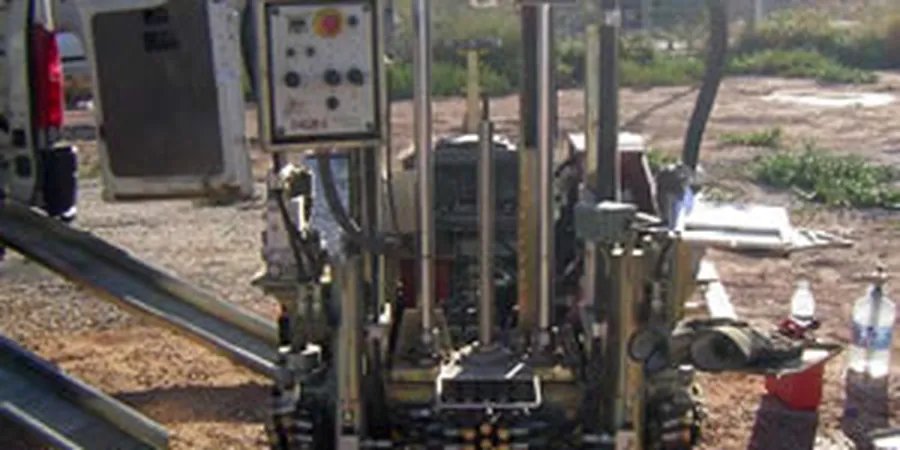
The CPT rig itself is a 20-tonne truck-mounted system with a hydraulic ram capable of 200 kN of push force. In Grande Prairie, we operate it on stabilized pads or timber mats when working on the soft organic silts found in the lowlands near Bear Creek. The primary technical risk is cone damage from boulder impact in the glacial till, which can shear the tip or destroy the sleeve load cell. We mitigate this with real-time inclination monitoring and a push-force alarm that halts advancement before structural overload, but a damaged cone means immediate downtime and recalibration in our mobile lab. A less visible but equally serious risk is desaturation of the pore pressure filter in the vadose zone — if the filter loses saturation, the u₂ reading becomes unresponsive, and the resulting q_t correction and SBT classification are unreliable. We run a saturation check and a Bq test at the surface before every single push, recording the baseline pore pressure decay curve to confirm hydraulic connectivity before interpreting any dissipation data.
Applicable standards
ASTM D5778-20 — Standard Test Method for Electronic Friction Cone and Piezocone Penetration Testing of Soils, NBCC 2015 — National Building Code of Canada, Section 4.2 (Foundations), seismic site class determination via Vs or SPT/CPT, CSA A23.3-19 — Design of Concrete Structures, Annex L for pile design using CPT-based methods (LCPC, ICP-05)
Associated technical services
Piezocone dissipation testing
We hold the cone at target depths to record pore pressure decay, from which we calculate the coefficient of consolidation (c_v) for Grande Prairie's silty clay layers, essential for predicting settlement time under embankment loads.
CPT-based liquefaction assessment
Applying the Robertson (2016) SBT-based method and the Boulanger & Idriss (2014) CPT trigger curves, we map liquefaction potential in the saturated sand lenses found beneath the city, directly feeding seismic site classification per NBCC.
Soil behavior type profiling with lab calibration
The continuous CPT SBTn log identifies soil layers at 1 cm resolution. We ground-truth boundaries with thin-wall Shelby tube samples and run triaxial CIU tests on the retrieved silt to calibrate the cone factor N_kt for the local geology.
Pile capacity analysis from CPT
Using the LCPC (French) and ICP-05 (Imperial College) direct CPT methods, we compute unit shaft friction and end bearing for driven and CFA piles, avoiding the need for extensive piles static load testing during preliminary design.
Typical parameters
Frequently asked questions
What does a CPT test in Grande Prairie typically cost per meter?
For a standard CPTu push in Grande Prairie, the investment ranges from CA$200 to CA$300 per meter, depending on total depth, access conditions, and whether dissipation tests are required. A full-day mobilization with 60-80 meters of testing and multiple dissipation holds typically falls toward the lower end of that range per meter. We provide a fixed-price quote after reviewing the site location and target depth.
Can CPT penetrate the glacial till found across the Grande Prairie area?
CPT can profile through the upper softened till and any interbedded silt and sand units, but it will refuse on the dense, bouldery lodgement till that underlies much of the region. Refusal typically occurs at tip resistances above 40-50 MPa or when a boulder is encountered directly. At that point, we recommend transitioning to a mud-rotary drill with SPT sampling to log the till and confirm bedrock depth.
How do you correct CPT data for the silty soils common in the Peace River region?
In the partially drained silts and silty clays typical of glaciolacustrine deposits here, we apply full pore pressure correction to convert measured q_c to corrected total tip resistance q_t. We then use the normalized soil behavior type chart (SBTn) from Robertson (2016), which accounts for overburden stress and the region's characteristic overconsolidation. Where possible, we calibrate the cone factor N_kt against a few high-quality Shelby tube samples tested in our triaxial lab to refine the undrained shear strength profile.