Our geotechnical laboratory in Grande Prairie provides essential soil classification tests governed by CSA and ASTM standards, tailored to the region's complex glacial till, lacustrine clay, and alluvial silt deposits. Accurate index testing begins with a complete grain size analysis (sieve + hydrometer) to define the particle distribution from coarse gravels down to fine colloids. We complement this with Atterberg limits testing to precisely measure the liquid limit, plastic limit, and plasticity index, capturing how these fine-grained soils transition between solid, semi-solid, and plastic states under varying moisture.
These fundamental parameters directly support foundation design, slope stability assessments, and infrastructure projects across the Peace Country, including residential subdivisions, pipeline right-of-ways, and municipal roadworks. Reliable laboratory data reduces geotechnical uncertainty when dealing with potentially compressible or frost-susceptible native soils. For a complete physical characterization, our grain size analysis and Atterberg limits reports deliver the critical inputs engineers require for soil classification under the Unified Soil Classification System.
Anchor bond capacity in Grande Prairie glaciolacustrine clay is governed more by pore pressure dissipation during grouting than by the undrained shear strength of the intact soil.
Methodology and scope
Local considerations
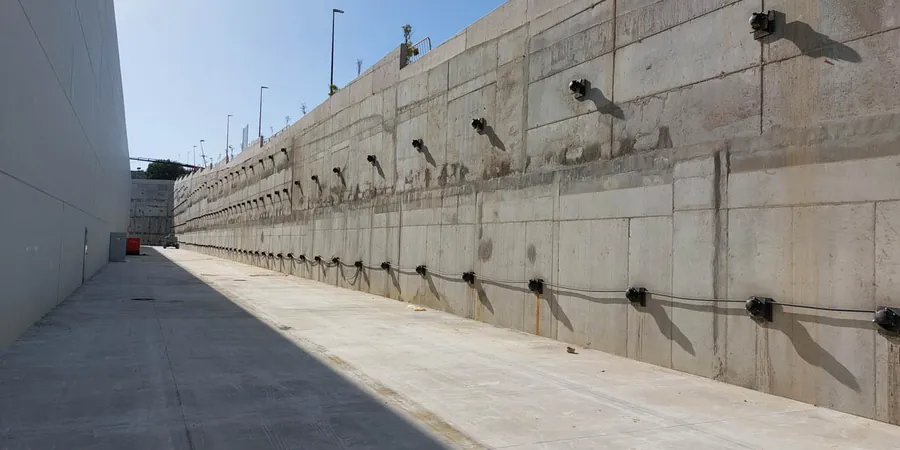
A fully instrumented hydraulic jack with a calibrated load cell and digital dial gauge system is mobilized to Grande Prairie sites for anchor performance and proof testing. The primary risk we encounter isn't tendon failure but progressive bond zone deterioration in stiff clay when cyclic seasonal moisture fluctuation causes shrinkage at the grout-clay interface, a mechanism that reduces passive resistance by as much as 25% over five years if the anchor was designed without a corrosion-protected double-corrugated sheathing extending into the bond zone. Installing sacrificial anodes and specifying a water-cement ratio no greater than 0.45 for the neat grout reduces this degradation pathway substantially, and every anchor is lift-off tested 72 hours after grouting to confirm the lock-off load hasn't drifted.
Applicable standards
CSA A23.3-19 Annex D – Anchorage to Concrete and Grouted Anchors, PTI DC35.1-14 – Recommendations for Prestressed Rock and Soil Anchors, ASTM A416/A416M-18 – Low-Relaxation Seven-Wire Steel Strand for Prestressed Concrete, CAN/CSA-G40.21-13 – Structural Quality Steels (anchor head components)
Associated technical services
Bond Zone Characterization
Laboratory direct shear testing of the grout-to-soil interface using remolded samples compacted to field density, providing site-specific ultimate bond stress values for both active and passive anchor designs in the Smoky River till.
Anchor Proof Testing Supervision
On-site monitoring of hydraulic jack loading sequences per CSA A23.3, including incremental load-hold cycles and creep movement measurement using digital dial gauges, with immediate pass/fail evaluation against the project acceptance criteria.
Tendon Corrosion Risk Assessment
Soil resistivity and pH profiling along the anchor borehole alignment to determine the required level of encapsulation protection, referencing FHWA guidelines for permanent ground anchors in northern climates with freeze-thaw cycling.
Typical parameters
Frequently asked questions
What distinguishes an active anchor from a passive anchor in retaining wall design?
An active anchor is prestressed to a lock-off load after grouting, which actively compresses the retained soil mass and limits wall deflection from the start. A passive anchor is not tensioned until the wall begins to move, meaning it relies on soil deformation to mobilize resistance. In Grande Prairie's stiff clay, active anchors are preferred for permanent hospital or school excavations where adjacent infrastructure is sensitive to settlement, while passive anchors can be suitable for temporary sheet pile walls where some lateral movement is tolerable.
How deep into the native till must the bond zone extend for a typical anchored wall in Grande Prairie?
The bond zone must be entirely within competent glacial till or clay below the active seasonal moisture variation zone, which in Grande Prairie extends to roughly 2.5 m depth. For a 6 m high wall, the bond length usually falls between 6 and 9 m depending on the undrained shear strength confirmed by laboratory triaxial testing. We verify that the bond zone is at least 1.5 m beyond any identified shear plane and that the confined grout-to-ground bond stress does not exceed values published in PTI DC35.1-14 for stiff cohesive soils.
What is the typical cost range for anchor design testing and proof testing in the Grande Prairie area?
For a complete anchor testing program, including laboratory bond shear testing, on-site proof testing of three to five anchors, and a detailed report with load-displacement curves, the investment generally ranges from CA$1,390 to CA$5,460 depending on the number of anchors in the program and the depth of the instrumentation required.
Can anchors be installed during Grande Prairie's winter months?
Winter installation is feasible but requires preheating the grout mixing water to at least 20°C and protecting the grouted anchor head with insulated blankets for 72 hours to ensure the neat cement grout reaches initial set before freezing. The bond zone soil temperature at depth remains above freezing year-round, so the critical factor is preventing the free-length portion from being compromised by ice lens formation at the collar during the curing period.
How is anchor creep evaluated during the proof testing stage?
During the proof test, the anchor is loaded in increments up to 133% of the design lock-off load, holding at each increment for a minimum of 10 minutes while measuring creep movement with a dial gauge reading to 0.025 mm. Creep movement must remain below 2.0 mm per log cycle of time per CSA A23.3 criteria; any anchor exceeding this threshold is de-tensioned, re-grouted if necessary, and re-tested until the movement stabilizes within the acceptable envelope.