The contrast between the South Bear Creek floodplain and the higher lacustrine terraces near Crystal Lake reveals a sharp divide in seismic performance across Grande Prairie. While the clay-rich till of the uplands often resists densification well, the saturated fine sands and silts found along the valley bottoms are prime candidates for soil liquefaction analysis when the Peace Country experiences its characteristic low-to-moderate seismicity. A site near the river with water at 1.8 meters behaves fundamentally differently from one up on the plateau with a deep water table, and our geotechnical investigations map these differences before a single footing is designed. The CPT testing we deploy in these soft zones provides a continuous profile of tip resistance and pore pressure, making it especially useful where thin, interbedded liquefiable lenses might be missed by traditional sampling alone.
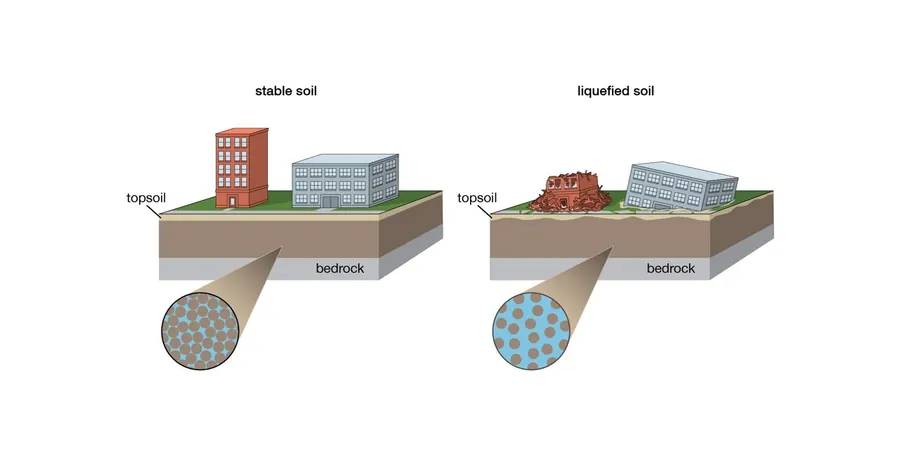
Liquefaction in Grande Prairie is not about strong shaking alone; it is about the combination of a high water table, silty sands, and the long-period motions that travel efficiently through the Western Canada Sedimentary Basin.
Methodology and scope
Local considerations
Under NBCC 2020, Grande Prairie falls within a seismic hazard zone that, while not as severe as coastal British Columbia, still produces spectral accelerations that require explicit soil liquefaction analysis for Site Classes D and E, especially where the groundwater is within 5 meters of the surface. The risk is compounded by the fact that much of the city's commercial and industrial expansion is occurring on the very glaciofluvial deposits that are most susceptible: loose to medium-dense sands with interbedded silts, often capped by a thin layer of stiff clay that masks the problem from the surface. A standard bearing capacity check will miss the post-liquefaction settlement, which can easily exceed 50 millimeters under the design earthquake, cracking slabs, tilting shallow foundations, and rupturing buried utilities. The cost of a detailed analysis is trivial compared to the cost of differential settlement in a warehouse floor or a tilt-up concrete building, and it is now a standard requirement for institutional and high-occupancy structures under Part 4 of the Alberta Building Code.
Applicable standards
NBCC 2020 (National Building Code of Canada) – Seismic Hazard and Site Classification, ASTM D1586-18 – Standard Test Method for Standard Penetration Test (SPT), ASTM D5778-20 – Standard Test Method for Electronic Friction Cone and Piezocone Penetration Testing, ASTM D5311/D5311M-13 – Cyclic Triaxial Test for Liquefaction Assessment, NCEER (1997/2001) – Summary Report on the Evaluation of Liquefaction Resistance
Associated technical services
Comprehensive Liquefaction Triggering and Settlement Analysis
We combine field data from SPT or CPTu borings with cyclic triaxial tests on undisturbed samples to calculate the factor of safety against liquefaction for each soil layer, using the updated simplified procedure. The deliverable includes contour maps of post-liquefaction volumetric strain, settlement predictions under the design earthquake, and a clear go/no-go recommendation for shallow foundations per NBCC and CSA A23.3 requirements.
Lateral Spreading and Ground Improvement Design Review
For sites adjacent to the Wapiti River or other watercourses where free-face lateral spreading is a concern, we run empirical displacement models to estimate lateral movement. When mitigation is necessary, we work with specialty contractors to design stone column grids, vibrocompaction programs, or rigid inclusion layouts, verifying post-improvement performance with follow-up CPT soundings and re-analysis of the liquefaction resistance ratio.
Typical parameters
Frequently asked questions
Is soil liquefaction analysis mandatory for all Grande Prairie construction projects?
Not for every project, but it is mandatory under NBCC 2020 for structures assigned to Site Classes D, E, or F with a groundwater table within 5 meters of the surface, particularly for Importance Category 2, 3, or 4 buildings. For single-family homes on competent till, it is rarely required, but for any commercial, industrial, or institutional development on the city's alluvial or glaciofluvial deposits, it has become standard practice.
What is the typical cost range for a liquefaction analysis in the Peace Country?
For a standard commercial lot in Grande Prairie, the analysis typically ranges from CA$3,060 to CA$6,520, depending on the depth of the investigation, the number of boreholes or CPT soundings, and whether cyclic triaxial testing is required on Shelby tube samples. A light industrial building with two SPT borings and a simplified triggering analysis will fall at the lower end, while a multi-storey development requiring advanced laboratory testing and ground improvement design review will approach the upper range.
How does the Grande Prairie soil profile affect liquefaction risk differently than in other Alberta cities?
Grande Prairie sits on thick sequences of glacial and post-glacial sediments, including buried meltwater channel deposits that are often finer and more loosely packed than the dense tills found in Edmonton or Calgary. The combination of a relatively shallow water table in the valley areas and the presence of silty sands with low plasticity fines makes the city's alluvial corridors more susceptible to cyclic pore pressure buildup than the more competent bedrock-surfaced areas to the south.
What field tests are most reliable for liquefaction assessment here?
We find that the CPTu provides the most continuous and repeatable data in the interbedded sands and silts common around Grande Prairie, but it is often paired with at least one SPT borehole to recover samples for grain size and Atterberg limits testing. The fines content and plasticity of the soil are decisive in correcting the penetration resistance, and without physical samples, the analysis can be overconservative or unconservative depending on the layer.
Can you perform the analysis in winter conditions?
Yes, winter drilling and CPT operations are routine in Grande Prairie. The main considerations are protecting the piezocone from freezing before insertion and ensuring that the drilling fluid does not freeze in the rods. Our equipment is winterized, and we have completed many January and February investigations where the only effect on the liquefaction analysis is a slightly lower groundwater table due to frost, which we account for by using the historical high water level rather than the frozen-season measurement.