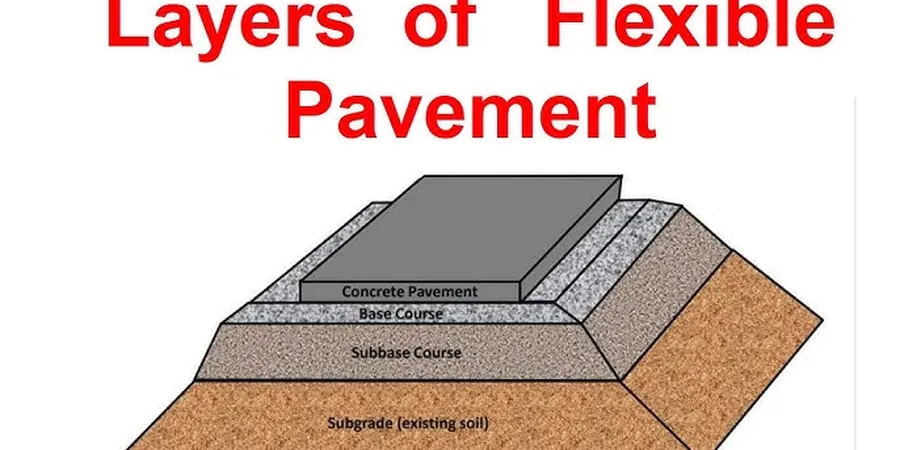
We see it all the time: a contractor paves a new lot in Grande Prairie in September, and by March the asphalt is cracked in a grid pattern that matches the frost heave beneath. The issue wasn't the asphalt mix—it was the subgrade preparation and the layer thicknesses that never accounted for a frost depth reaching 2.2 meters. Grande Prairie sits in a zone where winter temperatures can drop to -40°C, and the frost doesn't leave the ground until May. A proper CBR road subgrade study validates the bearing capacity before anyone lays geotextile, and a Proctor test confirms the compaction achievable with local silty clays. These are not optional checkboxes here; they're what keeps a parking lot from failing before its second winter.
A pavement is only as good as the worst 300 mm beneath it. In Grande Prairie, that means designing for a spring thaw that turns the subgrade to soup.
Methodology and scope
Local considerations
A warehouse distribution center off 116 Avenue was paved in July 2019 with a standard 100 mm asphalt over 200 mm granular base. By March 2021, the loading dock apron had rutted 40 mm deep and the access road showed alligator cracking across 60% of the surface. The post-mortem was straightforward: the subgrade was a glaciolacustrine clay with a plasticity index above 25, and the spring thaw had saturated the base course from below. The fix required full-depth reclamation with 4% cement stabilization, a geogrid at the subbase interface, and an additional 50 mm of asphalt. That project now serves as our reference case for why a flexible pavement design in Grande Prairie must start with an in-situ permeability test and an Atterberg limits profile of the upper 1.5 meters.
Applicable standards
AASHTO 1993 Guide for Design of Pavement Structures, ASTM D1557-12e1 (Modified Proctor for subgrade and base), ASTM D1883-21 (CBR of laboratory-compacted soils), Alberta Transportation Highway Geometric Design Guide (latest edition), CSA A23.1 Concrete Materials and Methods (for stabilized base)
Associated technical services
Subgrade investigation and CBR testing
Field CBR and DCP testing at proposed subgrade elevation, with lab CBR on remolded samples to establish the design modulus for each pavement segment.
AASHTO 93 structural design package
Full layer thickness determination using traffic projections, subgrade Mr, and regional climate factors. Stamped by a P.Eng. registered in Alberta.
Base course and aggregate quality control
Gradation, Proctor density, and sand equivalent testing on all imported granular materials to Alberta Transportation Class 25 or project-specific specs.
Post-construction proof rolling and density
Nuclear density gauge testing on each lift, plus Benkelman beam deflection testing where specified for final acceptance.
Typical parameters
Frequently asked questions
How much does a flexible pavement design package cost for a typical Grande Prairie commercial lot?
For most commercial or light-industrial projects in Grande Prairie, the engineering package—subgrade investigation, lab testing, AASHTO 93 design report, and construction QA—runs between CA$2,480 and CA$8,010, depending on the number of pavement segments, the depth of the geotechnical investigation, and whether full triaxial testing is required for the subgrade.
What is the minimum asphalt thickness for a parking lot in Grande Prairie given our frost?
There is no single minimum; it depends on the subgrade type and traffic. For passenger-vehicle parking on a well-drained granular subgrade, 80 mm of hot-mix asphalt over 250 mm of crushed base is the practical floor. Where silty clay subgrades are present, we typically specify 100 mm of asphalt with a cement-stabilized base layer to resist frost heave and spring breakup.
Do you use the same pavement design for oilfield lease roads as for commercial parking?
No. Lease roads in the Grande Prairie area carry loaded vacuum trucks and rig-moving equipment with axle loads that far exceed typical highway ESALs. We design those sections for a higher traffic category, often using a full-depth asphalt section over a mechanically stabilized aggregate layer, and we specify a stiffer binder grade to handle slow-moving, high-pressure loads during summer.