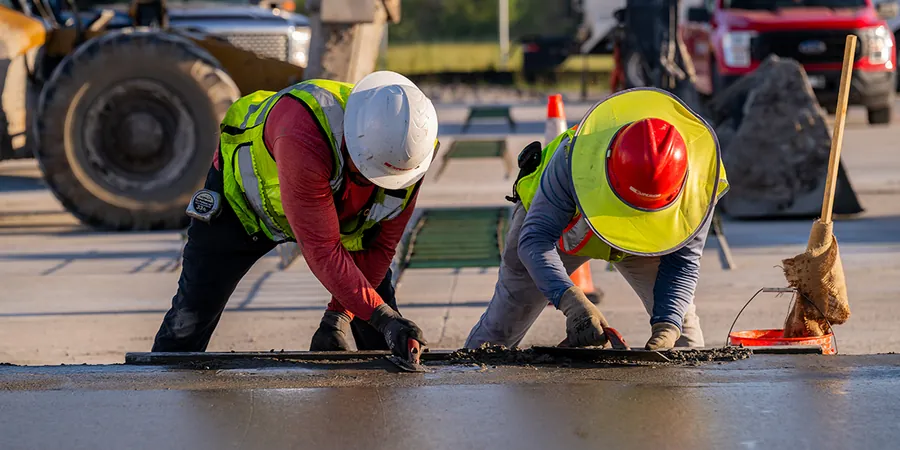
The Peace Country doesn't do mild. Grande Prairie sits at the edge of the boreal plain, where winter temperatures routinely plunge below -30°C and the frost line can dig well past two meters into the ground. Any engineer who has worked here knows that a standard rigid pavement design won't survive five years if the subgrade wasn't characterized for frost susceptibility. The silty clays and glaciolacustrine deposits common across the region swell when wet and heave when frozen, creating differential movements that crack portland cement concrete slabs from the bottom up. A proper rigid pavement design here starts not with the concrete mix, but with a detailed geotechnical investigation of what lies beneath. The team evaluates subgrade stiffness, drainage patterns, and freeze-thaw cycling to specify joint spacing, dowel bar placement, and base course materials that actually hold up. For projects in the industrial parks south of Highway 43, where loaded logging trucks and oilfield equipment impose repetitive axle loads, the fatigue analysis has to account for the combined effect of thermal curling stresses and heavy vehicle spectra rarely captured in textbook examples.
In Grande Prairie, the rigid pavement design has to answer two questions simultaneously: how the slab will curl under a minus-30-degree thermal gradient, and how the subgrade will behave when the spring thaw saturates everything underneath.
Methodology and scope
Local considerations
Section 4.2 of CSA A23.3 and the NBCC structural commentaries make clear that rigid pavement performance is dominated by subgrade uniformity, not just concrete quality. In Grande Prairie, ignoring the frost-susceptibility classification of the native till has led to slab faulting at joints within two freeze-thaw seasons. The biggest risk isn't the concrete failing in compression—it's the loss of support beneath the slab corners where curling stresses peak. When the subgrade is a CL-ML glacial silt with pockets of organics, as found near Bear Creek, differential heave can lift one panel relative to its neighbor by 15 millimeters or more, creating a trip hazard and destroying load transfer. A secondary risk is sulfate attack from the groundwater, which in some parts of the region exceeds 1,500 ppm soluble sulfates, requiring Type HS cement or blended binders. Without a site-specific rigid pavement design that incorporates drainage outfalls, capillary breaks, and joint sealing against water ingress, the owner inherits a maintenance liability that compounds annually.
Applicable standards
CSA A23.1/A23.2: Concrete materials and methods of concrete construction, CSA A23.3: Design of concrete structures (pavement provisions), ASTM D2487 / D2488: Unified Soil Classification for subgrade characterization, ASTM C78: Flexural strength of concrete (simple beam with third-point loading), NBCC 2020: National Building Code of Canada, structural commentaries
Associated technical services
Subgrade Evaluation and Frost Protection Design
In-situ testing with DCP and plate load, laboratory determination of frost-susceptibility index, and specification of non-frost-susceptible fill depth to meet NBCC requirements for the Grande Prairie frost zone.
Pavement Structural Analysis and Joint Layout
Finite element modeling of slab curling and traffic loading using PCA and ACPA methodologies. Joint spacing, dowel diameter, and tie-bar detailing optimized for the local temperature range and subgrade modulus.
Mix Design and Sulfate Resistance Verification
Concrete mix proportioning targeting MR ≥ 4.5 MPa with Type HS or Type GU cement plus supplementary cementitious materials, verified through trial batches and sulfate exposure testing per CSA A3004-E1.
Construction QA and Falling Weight Deflectometer Testing
On-site slump, air content, and flexural beam casting during placement, followed by FWD testing to confirm load transfer efficiency at joints and uniform support conditions before project handover.
Typical parameters
Frequently asked questions
What is the expected cost range for a rigid pavement design in Grande Prairie?
For a typical industrial or commercial project, the engineering design and construction QA package generally falls between CA$2,430 and CA$8,790, depending on the slab area, traffic loading complexity, and the extent of subgrade investigation required.
How does the extreme cold in Grande Prairie affect joint design?
The large temperature swing from summer highs around 30°C to winter lows below -35°C significantly increases slab curling and joint opening. We specify shorter joint spacing than in southern Alberta—typically 3.6 to 4.5 meters—and use skewed joints to reduce impact loads. Dowel bars must be sized to accommodate the full thermal contraction range without binding.
What subgrade problems are most common in the Grande Prairie area?
Glaciolacustrine silts and high-plasticity clays dominate, many with frost-susceptibility ratings of F3 or F4. We frequently encounter variable organic content near old drainage courses, and sulfate concentrations that mandate Type HS cement. A thorough geotechnical investigation before rigid pavement design is essential to map these conditions across the pad footprint.
Do you recommend doweled or undoweled joints for local industrial pavements?
Doweled joints are strongly recommended for any rigid pavement in Grande Prairie that will see truck traffic or heavy forklifts. The combination of frost heave potential and repetitive axle loads means undoweled joints inevitably fault over time, creating a rough surface and damaging material handling equipment. More info.