A CAT 320 excavator cutting into a Grande Prairie slope reveals exactly why retaining wall design here demands local experience. The exposed face shows a meter of silty clay over dense glacial till, with groundwater seeping at the contact. That interface is where walls fail if the designer never stood beside the trench. We specify drainage aggregate gradations that work with Peace River coarse materials, not generic specs copied from southern projects. Whether it’s a cantilever wall for a residential lot in Westpointe or an MSE structure holding back a commercial pad near the airport, the wall geometry, reinforcement, and backfill all respond to the same glacial stratigraphy that makes foundation decisions so site-specific here. A slope stability analysis often runs in parallel to confirm that the retained cut doesn’t trigger deeper movement, especially where the till contains lenses of softer lacustrine clay.
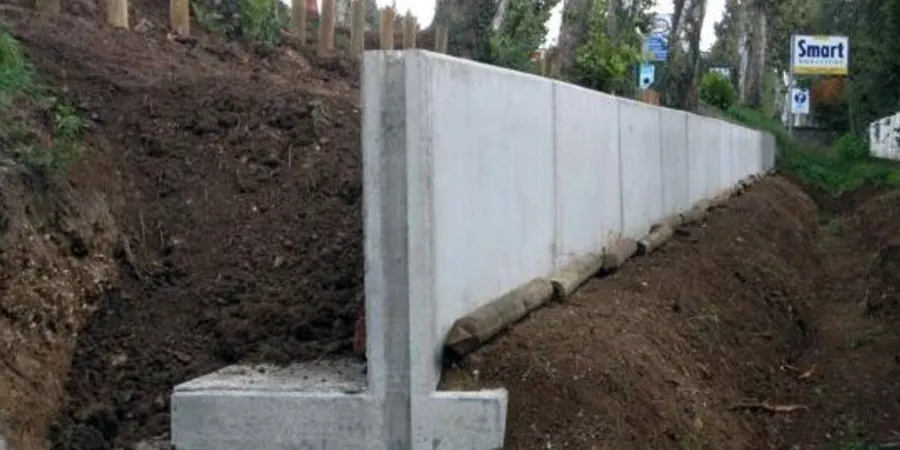
Frost depth in Grande Prairie exceeds two meters—your retaining wall footing must sit below that or the backfill must drain to prevent ice lensing behind the stem.
Methodology and scope
Local considerations
Grande Prairie’s freeze-thaw cycles punish retaining walls in ways that coastal BC designers rarely see. Air temperatures swing from minus 40°C to plus 30°C annually, driving frost heave in clay-rich backfill and thermal expansion in concrete stems. When spring meltwater saturates the retained soil faster than the drainage system can discharge, hydrostatic pressure spikes—walls tilt, crack, or slide. The Peace River region also sits in a moderate seismic zone, and a wall that barely meets static safety factors may not survive the 1-in-475-year ground motion that NBCC requires. We run pseudo-static analyses where the retained height exceeds 2 meters, adding a horizontal seismic coefficient that reflects the site class. Another risk unique to Grande Prairie is the presence of buried organic layers from ancient muskeg deposits. If excavation for the wall base uncovers peat, bearing capacity collapses. An SPT drilling program along the wall alignment catches those soft zones before concrete is poured, letting us deepen the footing or excavate and replace the unsuitable material.
Applicable standards
NBCC 2020 Division B Part 4 – Structural Design, CSA A23.3:19 – Design of Concrete Structures, ASTM D2488 – Description and Identification of Soils (Visual-Manual Procedure), AASHTO LRFD Bridge Design Specifications (Section 11 – Abutments and Retaining Walls, adopted by Alberta Transportation)
Associated technical services
Geotechnical investigation for wall alignment
We drill boreholes or excavate test pits along the proposed wall footprint, log stratigraphy, and recover samples for shear strength testing. A report defines design soil parameters, groundwater elevation, and frost-depth recommendations specific to your Grande Prairie site.
Structural wall design and stability analysis
We calculate overturning, sliding, and bearing capacity safety factors per NBCC limit-states requirements. Deliverables include stem and footing reinforcement schedules, backfill specifications, and drainage details ready for building permit submission.
Construction-phase inspection and materials testing
We verify subgrade bearing, backfill compaction, and reinforcement placement during construction. Proctor and sand cone density tests on the backfill lifts confirm that the placed material meets the design friction angle, reducing long-term settlement risk.
Typical parameters
Frequently asked questions
What type of retaining wall works best in Grande Prairie’s clay soils?
For cuts under 2 meters on stiff glacial till, a conventional cantilever reinforced-concrete wall usually performs well. Where the clay is softer—common near old drainage courses—we often recommend a mechanically stabilized earth (MSE) wall because it tolerates more differential settlement and reduces lateral earth pressure. Gravity walls in block or stone can work for low heights with deep drainage blankets, but frost heave potential must be addressed carefully.
Do I need a geotechnical investigation before building a retaining wall in Grande Prairie?
Yes, the City of Grande Prairie routinely requests a geotechnical report with retaining wall permit applications. The investigation confirms soil type, bearing capacity, groundwater depth, and frost susceptibility. Without it, the city may not accept the design, and more importantly, you risk building a wall on soft clay or peat that the excavation alone would not reveal.
How much does retaining wall design cost for a Grande Prairie project?
Design fees for a typical retaining wall in the Grande Prairie area range from CA$1,550 to CA$6,170, depending on wall height, length, complexity, and whether new boreholes are needed. A simple cantilever wall for a residential lot falls toward the lower end, while a tall MSE wall with multiple soil layers and seismic analysis moves toward the upper end.
How deep should a retaining wall footing be in the Grande Prairie area?
The bottom of the footing must be at least 2.1 meters below finished grade or below the local frost penetration depth specified by NBCC for Grande Prairie. If the wall uses non-frost-susceptible granular backfill with a functioning drainage system, the frost depth requirement can sometimes be reduced, but the footing still needs adequate bearing on undisturbed till or competent clay.