ASTM D1586 governs every SPT we run in Grande Prairie. The local stratigraphy, dominated by glacial till over Cretaceous shale, demands rigorous blow-count logging to separate dense preconsolidated layers from softer lacustrine clay pockets. A misread refusal depth here can shift a pile design by meters. We correlate N60 values directly with undrained shear strength for spread footings on the city's west side, where the Smoky River basin deposits create variable bearing conditions. Complementing the penetration data with a grain-size analysis helps confirm whether fines are controlling drainage behavior at depth, while Atterberg limits pin down the plasticity range of the clay seams that often surprise contractors during excavation.
N60 values from calibrated SPT rigs in Grande Prairie till eliminate the 15-20% uncertainty that raw blow counts introduce into bearing capacity calculations.
Methodology and scope
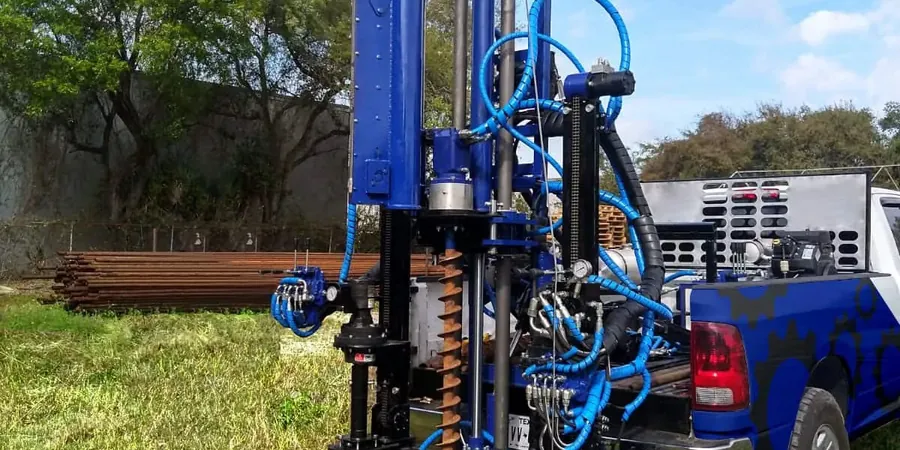
Local considerations
Grande Prairie sits at 669 m elevation on a plateau where glacial Lake Peace deposited thick sequences of varved clay. These rhythmically bedded silts and clays are notoriously sensitive to disturbance. An SPT executed without proper casing can smear the sidewalls and produce N-values that understate the true strength by 30% or more. The 2014 flood event along the Wapiti River demonstrated how quickly saturation can reduce effective stress in the near-surface till. Our logs flag zones where SPT blow counts drop below 4 in the upper 3 m, a threshold that correlates with potential bearing failure under seismic load per NBCC 2020 site classification. We also check for artesian conditions in the Paskapoo Formation sandstone; a pressurized aquifer encountered during drilling can blow out the borehole bottom and invalidate the test interval entirely.
Applicable standards
ASTM D1586-18, ASTM D4633-16, NBCC 2020 (seismic site class), CSA A23.3-14 (concrete foundations)
Associated technical services
SPT with N60 Correction
Energy-calibrated SPT with N60 reporting for foundation design in till and clay. Includes soil index testing for classification.
Borehole Logging Package
Complete geotechnical logs with SPT-N profiles, USCS classification, water level readings, and preliminary bearing capacity estimates per NBCC.
Combined SPT-CPT Correlations
Parallel SPT and CPT soundings to build site-specific correlation charts for Grande Prairie's glacial deposits, reducing uncertainty in deep foundation design.
Typical parameters
Frequently asked questions
What depth do you typically reach for SPT in Grande Prairie glacial till?
Most residential and commercial investigations go to 6-10 m depth. Dense till with N-values above 50 often causes refusal between 8 and 12 m. For deeper profiles into the Paskapoo Formation, we switch to rotary coring once SPT refusal is confirmed.
How do you handle winter SPT drilling when the ground is frozen?
We pre-thaw the upper 1.5-2 m with a heated casing or steam probe before advancing the hollow-stem auger. Frozen ground produces artificially high N-values; skipping this step gives misleading refusal data in the near-surface.
What does SPT testing cost in Grande Prairie?
Standard SPT investigation runs between CA$820 and CA$1,160 per borehole depending on depth, access conditions, and whether winter surcharges apply. This includes the calibrated N60 report and soil classification logs.
Do you report raw N-values or corrected N60?
We report N60 values corrected for hammer energy ratio per ASTM D4633. Raw field N-values are included in the appendix for transparency, but all design parameters in the main report use corrected N60.