The clay formations underlying Grande Prairie present a distinct challenge for earthworks and foundation design. Derived from glacial Lake Peace deposits, these surficial sediments exhibit high plasticity and significant volume change potential across the city’s freeze-thaw cycles. At 55 degrees north, winter frost penetrates well over two meters, while spring melt saturates the active layer—conditions that demand precise Atterberg limits data. A standard grain size analysis provides the particle distribution context, but it’s the plasticity chart that truly classifies the behavior of these lacustrine clays. Our laboratory processes samples from across the County, from the Westgate industrial parks to residential subdivisions near Bear Creek, delivering results that feed directly into bearing capacity corrections and swell potential estimates for local geotechnical reports.
The plasticity index of Grande Prairie lacustrine clays often exceeds 30%, classifying them as CH—highly compressible and moisture-sensitive.
Methodology and scope
Local considerations
A commercial building project on Resources Road encountered a 4-meter layer of glaciolacustrine clay with a natural water content hovering near the liquid limit. The soil was classified as CH based on a PI of 38. Heavy autumn rainfall before footing excavation softened the subgrade to a liquidity index above 0.9, effectively turning the bearing stratum into a near-liquid state. Without the Atterberg data flagging the sensitivity, the contractor would have placed footings on material with undrained shear strength below 25 kPa. The design team used the PI and clay fraction to estimate swell pressure and specified a 900 mm granular pad with a geotextile separator to mitigate volume change. In Grande Prairie, ignoring the Atterberg limits on a clay site doesn’t just risk settlement—it invites seasonal heave that can crack slab-on-grade floors within the first two winters, a cost no owner should absorb.
Applicable standards
ASTM D4318-17e1 – Standard Test Methods for Liquid Limit, Plastic Limit, and Plasticity Index of Soils, CSA A23.3 Annex M – Soil classification for concrete foundations on expansive clays, ASTM D2487 – Unified Soil Classification System (USCS) plasticity chart application, NBCC 2015 Division B, Article 9.12 – Soil bearing capacity and frost protection requirements for Plasticity Index
Associated technical services
Liquid & Plastic Limit Determination
Full ASTM D4318 test with four-point flow curve, plastic limit thread rolling, and PI calculation. Includes moisture content determination for each data point and classification per USCS.
One-Point Liquid Limit
Rapid liquid limit estimation for homogeneous clay units where the flow curve slope has been locally validated. Reduces sample volume and turnaround time for preliminary site assessments.
Shrinkage Limit & Swell Assessment
Shrinkage limit testing (ASTM D4943) combined with PI-based empirical swell potential estimation for Grande Prairie’s high-plasticity clays. Provides input for foundation uplift calculations.
Plasticity Index Profiling
Downhole PI profiling from continuous Shelby tube samples. Tracks Atterberg variation with depth to identify active zones where seasonal moisture fluctuation controls foundation performance.
Typical parameters
Frequently asked questions
What does a high plasticity index mean for my Grande Prairie building site?
A plasticity index above 20% typically indicates a clay with significant swell-shrink potential. In the Grande Prairie area, lacustrine clays often register PI values between 25 and 45. A high PI means the soil will expand when wet and crack when dry. For slab-on-grade construction, this translates to a risk of differential heave during freeze-thaw cycles. Engineers use the PI value to specify thickened-edge slabs, granular base courses, and sometimes deeper footings. The PI also feeds into the building code classification for expansive soils under NBCC Division B, which can trigger additional foundation reinforcement requirements.
How much does Atterberg limits testing cost in Grande Prairie?
Atterberg limits testing in Grande Prairie typically ranges from CA$90 to CA$140 per sample, depending on whether you need the full liquid limit and plastic limit suite or just a one-point liquid limit check. The price includes sample preparation, moisture content determination, and a test report with the plasticity chart classification. Expedited turnaround may carry a modest surcharge. For multi-sample projects, we provide consolidated pricing that lowers the per-unit cost.
How long does it take to get Atterberg limits results?
Standard turnaround for Atterberg limits testing is three to four business days from sample receipt. The process involves wet preparation, overnight oven drying for the initial moisture content, and then the actual liquid limit and plastic limit procedures—each of which requires careful manual execution and multiple data points. For larger projects with batch sampling, we can schedule a staggered workflow that delivers results on a rolling basis. Rush service is available for an additional fee and can produce a report within 24 hours.
Which ASTM standard do you follow for the liquid limit test?
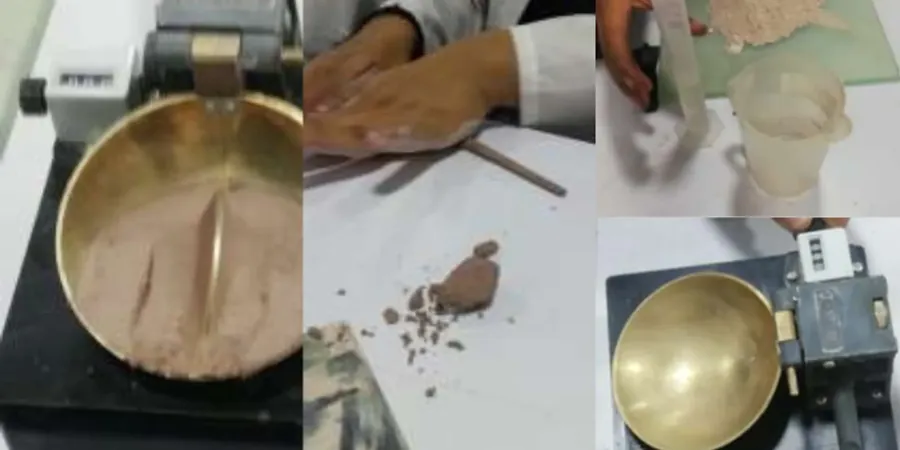
We perform all Atterberg limits testing in accordance with ASTM D4318-17e1, which specifies the Casagrande cup method for liquid limit and the thread-rolling method for plastic limit. The standard requires that the cup assembly be calibrated to a drop height of 10 mm and that the groove be cut with the flat ASTM grooving tool perpendicular to the hinge. We also maintain proficiency with the fall cone method per BS 1377 and CAN/BNQ 2501-090, which sometimes serves as a supplementary liquid limit check on highly plastic Grande Prairie clays where the Casagrande method shows greater operator variability.