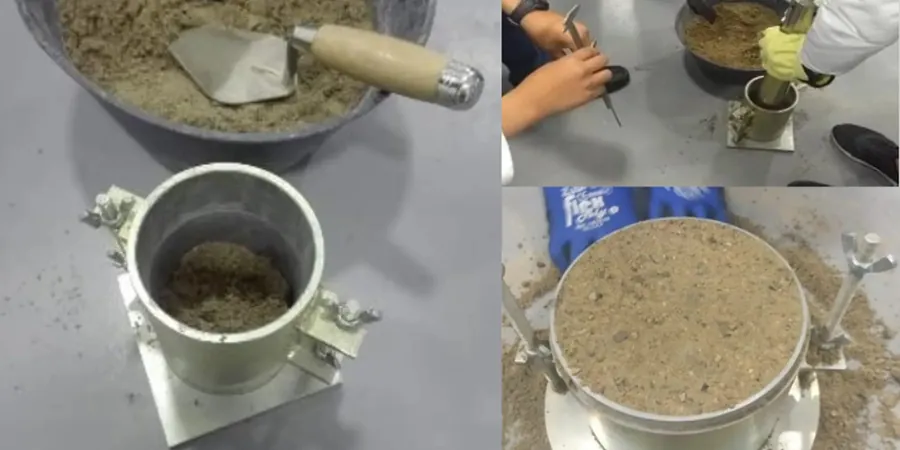
Grande Prairie's evolution from a Hudson's Bay trading post to the hub of the Peace Region has placed immense demands on its infrastructure. The heavy truck traffic along Highway 43 and the constant expansion of energy-sector facilities require earthworks that can withstand extreme freeze-thaw cycles and substantial structural loads. A Proctor test determines the precise moisture-density relationship of local clay tills and silty sands, establishing the target values that field compaction crews must achieve. Without this laboratory benchmark, density testing with a sand cone in the field has no reference standard, leaving engineers unable to verify whether a subgrade or utility trench backfill meets the project specification.
A Proctor curve is not just a graph; it is the contractual benchmark that decides whether a million-dollar earthwork passes or fails QA.
Methodology and scope
Local considerations
The geotechnical contrast between the higher, well-drained gravelly terraces near Bear Creek and the low-lying lacustrine clay plains east of the city illustrates the risk of using default Proctor values. Material from a pit in the west may reach 98% Standard Proctor density with routine moisture conditioning, while the same compactive effort on the silty clays found in the Clairmont area can leave the fill unstable and prone to excessive settlement. Laboratory Proctor testing eliminates this guesswork. When backfill around deep utilities in these sensitive clays is placed too wet, the soil structure collapses upon loading, leading to differential settlement that manifests as pavement cracking within the first two winters. A proper Proctor curve, combined with field nuclear gauge testing, ensures the placed material remains within the specified moisture band, avoiding both overcompaction in dry conditions and pore pressure buildup when too wet.
Applicable standards
ASTM D698-12: Standard Test Methods for Laboratory Compaction Characteristics Using Standard Effort, ASTM D1557-12: Standard Test Methods for Laboratory Compaction Characteristics Using Modified Effort, ASTM D2216: Standard Test Method for Laboratory Determination of Water Content, CSA A23.1: Concrete Materials and Methods of Concrete Construction (referenced for backfill requirements), City of Grande Prairie Engineering Design and Construction Standards (2022 Edition)
Associated technical services
Standard Proctor (ASTM D698)
Appropriate for residential subdivisions, landscaping fills, and lightly loaded commercial pads where typical compaction equipment exerts moderate energy. We report the zero-air-voids curve alongside the moisture-density relationship to validate result consistency.
Modified Proctor (ASTM D1557)
Specified for heavy-duty pavements, airport runways, and industrial facility pads in the Grande Prairie energy sector. The higher compactive effort simulates sheepsfoot rollers and heavy vibratory compaction, yielding a higher maximum density at a lower optimum moisture content.
Typical parameters
Frequently asked questions
What is the cost of a Proctor test in Grande Prairie?
Standard Proctor testing typically ranges from CA$120 to CA$310 per sample, depending on whether a single-point or full five-point curve is required and the material gradation method. Expedited turnaround for active construction sites may affect the final price. We provide a firm quote once we review the project specification and sample quantity.
How much material do you need for a Proctor test?
We require approximately 20 kg of representative disturbed soil per sample. For coarse materials with significant gravel content, the six-inch mold method (ASTM D698 Method C or D1557 Method C) may require up to 35 kg. The sample should be shipped in sealed plastic bags to preserve the natural moisture content.
When should I use Modified Proctor instead of Standard Proctor?
Modified Proctor applies to projects anticipating heavy wheel loads, such as highway embankments on Highway 40, industrial plant yards, or compacted aggregate base under rigid pavements. Standard Proctor suits low-rise foundations, landscaping fills, and utility trench backfill in areas without heavy traffic. Always check the project specification; it will state the required compactive effort and minimum percent compaction.
How long does a Proctor test take to complete?
A standard five-point Proctor curve with overnight moisture conditioning typically takes 2 to 3 business days. We offer same-day or next-day reporting for single-point verification tests when the material source has already been characterized. Contact our lab to confirm current turnaround times during the peak May through September construction season.