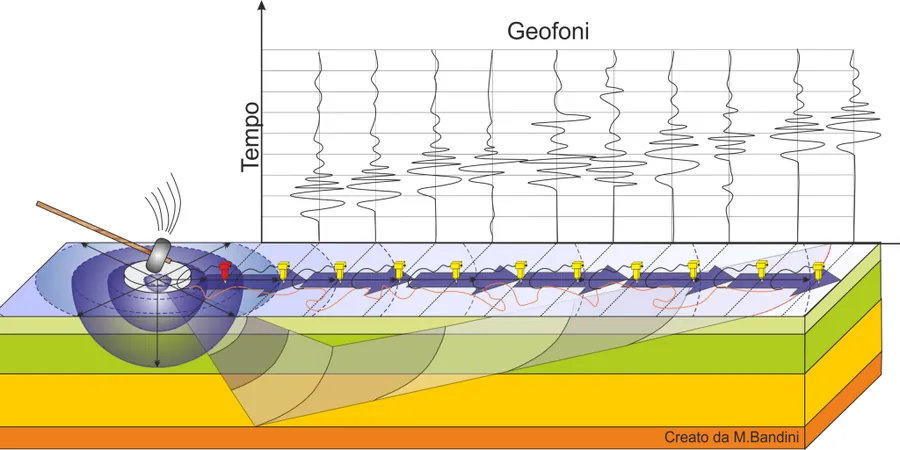
The biggest mistake we see in Grande Prairie is a structural design that assumes the ground is uniform. It isn't. A routine borehole log will tell you about the clay and till layers, but it won't tell you how fast shear waves travel through them until you do a dedicated MASW survey. We have picked up VS30 values varying by more than 150 m/s between two lots separated by less than three blocks in the downtown area, purely because of differences in the shallow glacial lake sediments. That difference can bump a site from Class C to Class D under NBCC, and if the structural engineer never gets that data, the seismic loads are underestimated. Our crew runs the active MASW spread with 24 geophones and a sledgehammer source, processing the dispersion curve right in the field so we can flag problem spots before demobilizing.
A VS30 difference of 100 m/s can change your NBCC site class and your seismic design loads by 20% or more.
Methodology and scope
Local considerations
Two areas in Grande Prairie illustrate the risk of skipping a VS30 measurement. In the heavy clay plains east of Bear Creek, the shear wave velocity in the upper 10 metres can sit well below 200 m/s because of the soft, saturated lacustrine deposits. That is a textbook Class D or even Class E site, and the amplification factors under NBCC will drive up the design base shear. Move west toward the Dunvegan Formation outcrops near the Wapiti River, and the same depth of investigation can return velocities above 400 m/s, putting you in Class C territory. A geotechnical report that omits the VS30 and assumes a default site class is gambling. The structural design either becomes unconservative on the soft side or wastes steel on the stiff side. For any project with a moment frame, a shear wall system, or a suspended slab, the liquefaction assessment should also be considered alongside the VS30, because the fine-grained soils in the region can trigger a different set of code requirements.
Applicable standards
NBCC 2020 – Table 4.1.8.4 Site Classification for Seismic Site Response, ASTM D4428/D4428M-14 – Standard Test Methods for Crosshole Seismic Testing (surface-wave adaptation), NEHRP Recommended Seismic Provisions for New Buildings – Site Class Definitions (Vs30)
Associated technical services
VS30 Site Classification Package
Full active MASW survey with one to three spread locations, dispersion curve extraction, inversion to 1D VS profile, and a signed report with the NBCC site class letter. Designed for building permit submissions in the City and County of Grande Prairie.
Combined MASW + SPT Verification
For greenfield industrial and multi-storey residential projects, we run the MASW line and follow it with an SPT borehole at the same location. The direct correlation between N-value and VS gives the structural engineer a defensible site-specific amplification factor.
Typical parameters
Frequently asked questions
How much does a MASW survey cost in Grande Prairie?
For a standard VS30 site classification with one spread location in the Grande Prairie area, the cost ranges from CA$2.020 to CA$4.120 depending on access conditions, number of spreads, and whether we need to clear snow or brush. A two-spread survey on a larger lot will be at the upper end. We include the dispersion analysis, inversion, and the signed site class letter in that price.
How long does it take to get the VS30 report after the field survey?
Field work for one MASW spread takes about two to three hours on site. After that, we process the dispersion curves and run the inversion model overnight. The draft report with the VS profile and the NBCC site class letter is typically in your inbox within three business days. If the structural engineer needs the site class faster to meet a permit deadline, we can fast-track the processing.
Can MASW work on frozen ground in a Grande Prairie winter?
Yes, but with caveats. Frozen ground increases the near-surface velocity and can bias the VS30 if the freeze depth is significant. We prefer to do the survey when the thaw depth is at least one metre, usually from May through October. If a winter survey is unavoidable, we apply a correction based on local freeze-depth data from Environment Canada and note it in the report so the engineer can adjust the site class interpretation.
What is the difference between MASW and seismic refraction for site class?
Seismic refraction gives you a P-wave velocity model and works best when the velocity increases with depth. MASW gives you the shear-wave velocity directly, which is what NBCC needs for site classification. In Grande Prairie's glacial stratigraphy, where soft clay can sit over stiffer till, refraction can miss a low-velocity layer that MASW will catch. For VS30, MASW is the right tool.