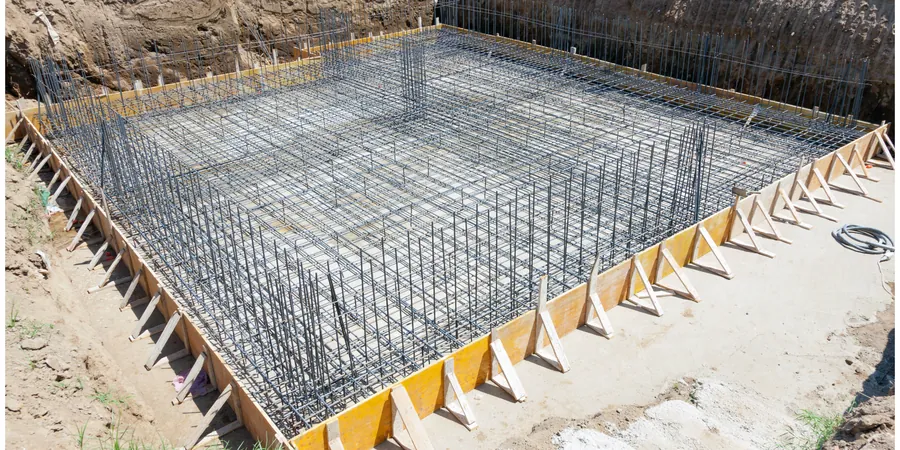
A few winters back, we reviewed a commercial building project off Resources Road where the initial boreholes showed more variability than the owner expected—stiff clay till at one corner, softening to a siltier matrix just twelve meters away. The structural engineer called our geotech team and asked whether isolated footings could handle the differential settlement, and the honest answer was no. That conversation led to a raft foundation design that spread the load across the entire footprint, smoothing out the stiffness contrasts that are so common here. Grande Prairie sits on a complex glacial legacy of the Peace River country, and the lacustrine silts and clays that underlie much of the city’s west side demand more than a textbook approach. When we pair subsurface characterization with a properly tuned modulus of subgrade reaction, the mat becomes a predictable system rather than an oversized guess. For sites where the stratigraphy shifts abruptly, we often recommend a CPT test early in the investigation to capture continuous tip resistance and pore pressure data without gaps that conventional SPT intervals can miss.
A well-calibrated modulus of subgrade reaction turns a raft foundation from a concrete slab into a load-distribution system that handles the stiffness contrasts buried in Grande Prairie’s glacial stratigraphy.
Methodology and scope
Local considerations
The contrast between Grande Prairie’s west-side neighborhoods and the older residential pockets near the downtown core tells a clear geotechnical story. West of 100 Street, the glacial lake sediments are thicker and more compressible, and we’ve measured undrained shear strengths below 50 kPa in the upper three meters on several sites. Over by the Avondale area, you’re more likely to hit dense till within a meter or two of grade, which changes the entire settlement profile. A mat foundation on the west side has to be designed with the soft layer in mind—otherwise seasonal moisture cycles in the active zone can trigger differential movements that crack partition walls and bind doors. The biggest risk we see isn’t total settlement; it’s the angular distortion between column lines that sit over different soil stiffnesses. That’s why our analysis includes sensitivity runs where we vary the subgrade modulus by ±30% across the slab footprint, checking whether the reinforcement detailing can redistribute the moment demands without serviceability issues.
Explanatory video
Applicable standards
NBCC 2020 (Division B, Part 4 — Structural Design), CSA A23.3:19 (Design of Concrete Structures), ASTM D2488 (Visual-Manual Description of Soils), ASTM D1195/D1196 (Plate Load Tests for kₛ calibration)
Associated technical services
Geotechnical Investigation for Mat Foundation Design
Field program including CPT soundings, test pits, and selective sampling to characterize the till, silt, and clay sequence. Laboratory testing covers consolidation (oedometer), unconfined compression, and Atterberg limits to define the compressibility and strength parameters needed for settlement analysis and subgrade reaction calibration.
Structural Design and Soil-Structure Interaction Analysis
Finite element or beam-on-elastic-foundation modeling of the raft slab with variable spring stiffness mapped from the geotechnical profile. Includes flexural and punching shear checks per CSA A23.3, reinforcement detailing, and frost protection detailing per NBCC requirements for the Grande Prairie climate zone.
Typical parameters
Frequently asked questions
What is the typical cost range for a raft foundation design in Grande Prairie?
For a geotechnical investigation plus structural design package, costs typically range from CA$1,470 to CA$4,970 depending on the building footprint, number of boreholes or CPT soundings required, and the complexity of the soil-structure interaction analysis. A smaller single-storey commercial pad on straightforward till will fall toward the lower end; a multi-storey structure on compressible west-side silts with extensive laboratory testing and multiple design iterations will be at the upper end.
How does Grande Prairie’s frost depth affect raft foundation design?
The NBCC assigns a frost penetration depth exceeding 2.0 meters for the Grande Prairie region, which is among the deepest in Alberta. A raft foundation must either bear below this depth or incorporate rigid insulation systems that prevent frost heave from reaching the underside of the slab. We typically specify extruded polystyrene insulation extending horizontally beyond the slab perimeter, with the configuration verified against thermal modeling that accounts for the building’s heated interior.
When is a raft foundation preferred over isolated footings in this area?
A raft becomes the better choice when the near-surface soils show significant lateral variability—something we encounter regularly in Grande Prairie’s glacial terrain. If two adjacent boreholes show markedly different stiffness or if the compressible silt layer exceeds three meters in thickness, isolated footings tend to produce unacceptable differential settlement. Rafts also work well when the total building load is high relative to the footprint and when the water table is shallow enough that excavation for deep footings becomes impractical.
What soil parameters are most critical for the subgrade reaction modulus?
The modulus of subgrade reaction depends primarily on the soil’s modulus of elasticity and Poisson’s ratio, both of which we derive from consolidation and triaxial testing on undisturbed samples. In Grande Prairie’s clay till, we also factor in the preconsolidation pressure because the deposit is often overconsolidated from glacial loading. Plate load tests provide the most direct kₛ values, but when those aren’t feasible, we back-calculate from settlement analyses using elastic half-space methods correlated to the site’s stratigraphy.
How long does the design and investigation process take?
A typical program runs three to five weeks from mobilization to final stamped drawings. Fieldwork—CPT soundings, test pits, and sampling—usually takes two to three days on site. Laboratory testing adds seven to ten days for consolidation and strength tests. The geotechnical report with design parameters follows within a week of lab results, and the structural design and drafting of the raft reinforcement plans requires another week, assuming no major redesign iterations are triggered by unexpected subsurface findings.